Most B2B brands are building authority in the one place AI will never look.
The Partner Authority Flywheel: Why AI Rewards Ecosystems, Not Individual Brands
AI discovery doesn't work the way most B2B marketers assume.
Brands invest heavily in owned content, search optimization, and domain authority, believing visibility follows volume. But when buyers turn to AI systems for vendor recommendations, a different set of rules applies. Authority isn't a function of how much you publish on your own site. It's a function of where your insights appear across the ecosystem.
When Authority Became a Network Effect
For two decades, B2B marketers optimized for Google. The equation was clear: produce high-quality content, build domain authority, earn backlinks, rank higher. Owned domains were assets. Content volume mattered. SEO was the lever.
AI-mediated discovery operates differently. Large language models don't crawl and rank individual pages the way search engines do. They synthesize answers by identifying patterns across multiple sources, weighting content based on the trustworthiness of the domains hosting it, and prioritizing information that appears in varied, independent contexts.
This shift is already reshaping buyer behavior. Gartner research shows that 89% of B2B buyers now use generative AI for vendor discovery. When buyers turn to AI systems for recommendations, those systems construct trust through distributed expertise, cross-referenced validation from multiple trusted sources, and contextual reinforcement from partner and publisher domains.
Analysis of AI citation behavior reveals a structural advantage for ecosystem-distributed content. Stanford University research shows LLMs are 2.3× more likely to cite information appearing across multiple independent domains versus a single site. Microsoft Research found that high-authority external domains, publishers, analysts, associations, receive 3-4× greater retrieval weighting than vendor-owned websites.
The gap widens when examining consideration triggers, the moments when AI systems recommend solutions to buyers. Meta AI research demonstrates that LLMs cite content from high-authority multi-author domains 4-12× more often than equivalent content on corporate blogs, even when relevance is identical.
Why? Because ecosystems have what owned domains lack: embedded audiences actively seeking solutions, higher domain trust that AI models recognize, richer topical context that improves relevance matching (Princeton found context-rich environments score 32% higher on semantic relevance tests), and editorial validation that signals quality.
LLMs treat publisher and partner networks as trusted reference layers, the same way a consultant leans on analyst reports, not corporate brochures. If your content doesn't live in the authority layer of the web, AI won't find it, and neither will your buyers.
Authority has become a network effect. To master this shift, leaders must internalize the three mechanisms that accelerate the Partner Authority Flywheel:
Three Forces That Drive the Flywheel
1. High-Trust Signal Distribution
AI weighs content hosted on publisher, analyst, partner, and integrator domains more heavily than content on a brand's own site. The reason is structural: these environments exhibit higher topical density, editorial oversight, diverse authorship, and long-tail context, signals AI uses to assess trustworthiness.
Your expertise becomes exponentially more influential when embedded in places AI already trusts. A white paper on your website is a claim. The same insights published in an industry journal, referenced in an analyst report, and discussed in a partner hub become validated expertise.
DeepMind research confirms that LLMs disproportionately trust domains with established citation histories. Partner and publisher sites qualify, most vendor blogs do not. This isn't about gaming the system. It's about understanding how trust signals work in retrieval-based systems.
The implication: owned domains remain necessary for brand control and lead capture, but they are insufficient for discovery. The brands that will dominate AI-mediated consideration sets are those whose insights live natively in the environments where buyers and AI systems conduct research.
2. Cross-Ecosystem Validation
AI models don't search for a single definitive source, they search for clusters. When your perspective appears across a partner hub, a publisher site, an association report, and a reseller ecosystem, the model recognizes the pattern. Your authority strengthens because it's contextually reinforced, not simply asserted.
When your methodology is cited in a Gartner report, featured in a TechTarget article, and referenced in a partner's implementation guide, AI doesn't see three separate mentions. It sees corroboration. Pattern recognition kicks in.
This is why isolated content, no matter how good, struggles to break through. A brilliant insight published only on your blog remains a claim. That same insight appearing across industry publications, analyst commentary, and partner content becomes a validated pattern.
OpenAI's retrieval guidance confirms that scoring prioritizes multi-source corroboration, high-authority domains, structured cite-ready content, semantic density, and editorial-style content quality. The architecture of discovery favors distribution, not concentration.
The more nodes you activate, the stronger the flywheel turns. The brands building compounding authority aren't publishing more. They're activating ecosystems to carry their perspectives into the environments where AI systems look for validation.
3. Compounding Visibility
The final force is acceleration: the self-reinforcing effect of being cited, referenced, and surfaced across multiple high-authority environments.
As distribution increases, signals multiply. As signals multiply, AI confidence strengthens. As AI confidence strengthens, your content surfaces more frequently in generated responses and shortlists. This creates a compounding loop, the flywheel accelerates itself.
Citations don't just reflect authority, they create it. The more frequently AI systems reference your brand, methodology, or framework, the more likely they are to reference you again. Success becomes self-reinforcing.
This is the true power of the Partner Authority Flywheel. When your insights appear across publisher sites, analyst reports, and partner hubs, you're not just reaching buyers directly. You're training AI systems to recognize your brand as a credible reference point for future queries.
Every mention strengthens the next. Every citation increases the likelihood of inclusion in consideration sets. Authority compounds.
Accenture research shows that buyers rate insights appearing on multiple independent sources as significantly more trustworthy than insights hosted solely on a vendor site. The Edelman Trust Barometer found that analysts, partners, ecosystems, and industry experts are 2-3× more trusted than vendor-produced content. This trust gap translates directly into discovery advantage.
Brands with distributed presence don't just gain visibility, they create gravitational pull. They become unavoidable because the ecosystem itself amplifies their authority.
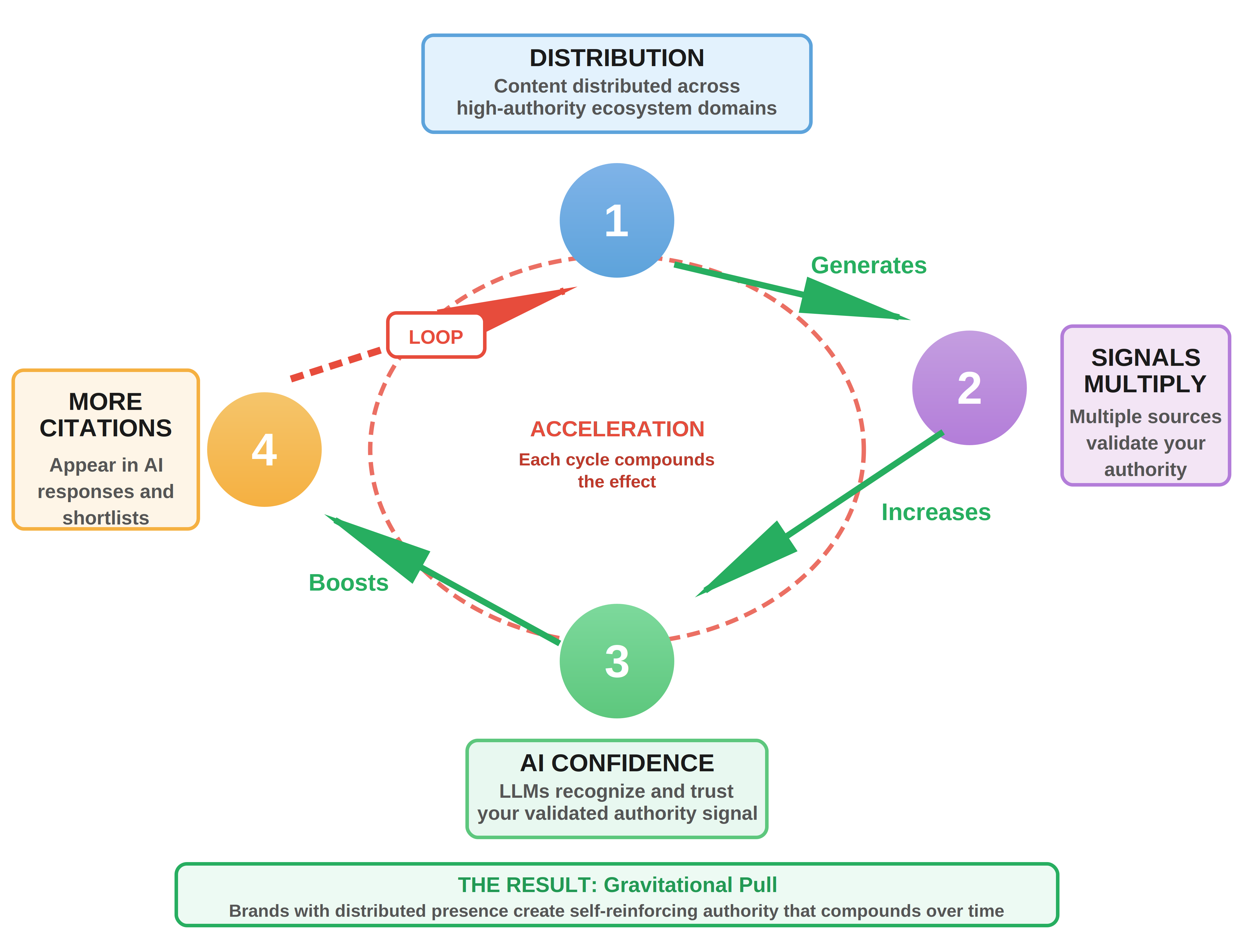
The Partner Authority Flywheel The self-reinforcing loop where distributed content creates compounding visibility. Each mechanism strengthens the next, turning ecosystem presence into gravitational pull.
Key Insight: Authority is now a network effect. Brands that keep expertise on their own domain signal irrelevance to the systems shaping buyer decisions.
Why Ecosystems Outperform Owned Domains
Analysis of AI citation behavior shows that content hosted on third-party domains, industry publishers, partner sites, analyst platforms, consistently receives higher citation rates than identical content on brand websites. The structural advantage is clear: ecosystem environments provide embedded audiences actively seeking solutions, higher domain trust that AI models recognize, richer topical context that improves relevance matching, and editorial validation that signals quality.
LLMs treat publisher and partner networks as trusted reference layers, the same way a consultant leans on analyst reports, not corporate brochures. When buyers ask AI systems for guidance, those systems default to sources that demonstrate independent credibility.
If your content doesn't live in the authority layer of the web, AI won't find it, and neither will your buyers.
What Leaders Risk by Ignoring This Shift
If your organization still treats content as something that lives exclusively on your website, you inadvertently signal irrelevance to AI systems.
Owned content still matters, it establishes your narrative, houses product detail, and anchors your brand story. But it's no longer sufficient for discovery. Brands slow to adopt ecosystem-led distribution will experience:
- Declining organic visibility as AI systems favor distributed signals over isolated domains
- Shrinking consideration sets as competitors activate partner networks
- Lost competitive differentiation when your insights remain invisible to buyers
- Reduced shortlist presence that compounds over time
- Lower win rates with no observable cause, pipeline metrics erode quietly
This is how brands disappear without anyone noticing, until the deals stop closing.
The executive challenge is perceptual. Most leadership teams still measure content success through owned metrics: pageviews, time on site, form fills. These metrics mask the larger erosion happening in AI-mediated discovery. By the time the dashboard shows trouble, you've already lost eighteen months of ecosystem-building opportunity.
IDC research shows that vendors activating partner and publisher ecosystems see 28% higher deal velocity and 22% higher shortlist inclusion. This isn't a content problem. It's an architecture problem.
The question isn't whether to invest in owned content. It's whether owned content alone is sufficient to drive discovery in an AI-mediated world. The data says no.
Five Moves to Activate the Partner Authority Flywheel
Leaders who recognize this shift can act decisively. Here are five priorities:
1. Strategically Reallocate Content Investment. Identify 10 to 15 trusted domains, publishers, partners, integrators. Allocate 40 to 50% of content investment to creating assets specifically designed for these high-trust environments, not repurposed from your blog.
2. Engineer Content for Citability and Portability. AI extracts and references content that's easy to parse. Build named frameworks, modular insights, and structured models that LLMs can cite cleanly. The goal is content that travels.
3. Deploy Embedded Content Hubs at Scale. Use content distribution platforms to publish natively across multiple trusted environments. This is not syndication, it's creating bespoke assets that live permanently in partner domains, optimized for each audience and platform.
4. Institutionalize Ecosystem Measurement. Audit how often you appear in AI-generated shortlists, expert syntheses, and recommendation engines. Measure "Share of Answer," tracking which partners and publishers drive the most citations, the only way to measure what truly drives discovery.
5. Treat Partnerships as a Visibility Engine. Partners aren't simply routes to market, they're routes to authority. Invest in co-created content and partner-hosted thought leadership. Design programs that systematically embed your expertise across multiple nodes over time.
The question isn't whether this shift is happening. It's whether you can survive the consequences of waiting.
References
- Stanford University (2024): Multi-Source Reinforcement in Large Language Models
- Microsoft Research (2024): Domain Authority Weighting in AI Retrieval Systems
- Meta AI (2023): Citation Patterns in Large Language Models
- Princeton University (2024): Semantic Relevance in Context-Rich Environments
- DeepMind (2024): Anchor Domain Bias in Large Language Models
- Gartner (2024): B2B Buyer Behavior and AI Adoption Study
- OpenAI (2024): Retrieval Guidance and Scoring Priorities
- Accenture (2024): Multi-Source Authority and Buyer Trust Research
- Edelman Trust Barometer (2023): Third-Party Trust in B2B Content
- IDC (2023): Ecosystem Distribution Impact on Sales Velocity and Shortlist Inclusion